
Moving Family 90 Day Sequence: Practical Dubai Relocation Guide
10 min read 9
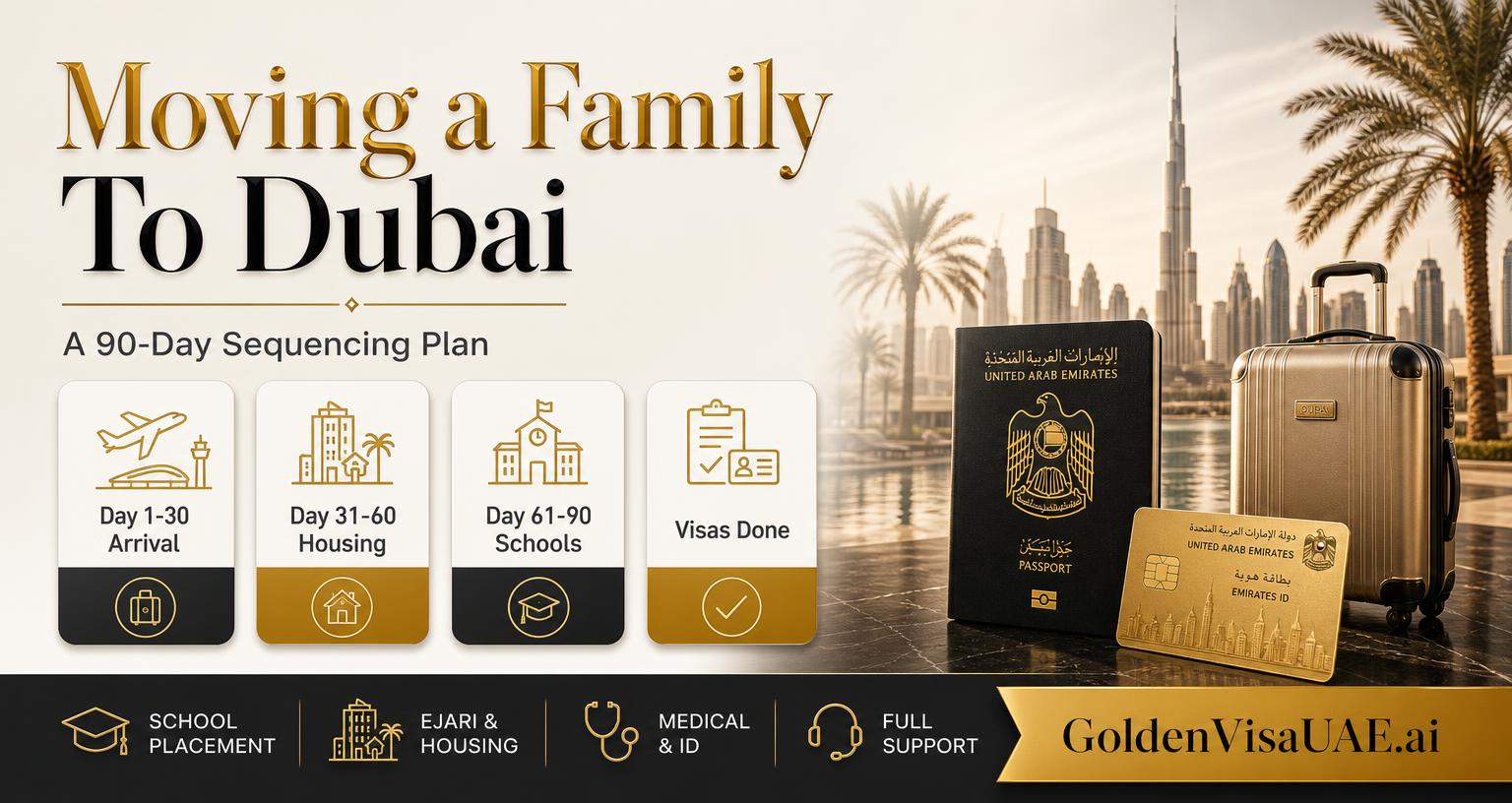
A dependency-led 90-day relocation plan for families moving to Dubai, covering document attestation, Ejari rules, visa cost differences, and school registration.
Quick answer
A family relocation to Dubai succeeds or stalls based on dependency timing. Complete home-country attestation for marriage and birth certificates two to three months before your move. Secure the sponsor residency and tenancy contract (Ejari) first. Apply for family entry permits while dependants are still abroad to avoid inside-country change-of-status fees, saving substantial costs per applicant, then complete medical tests and biometrics upon arrival.
Executing a successful move to the UAE requires disciplined scheduling rather than basic checklists. When organising a moving family 90 day sequence, expat parents often assume administrative tasks run in parallel. In reality, Dubai immigration and regulatory systems operate as strict linear dependencies. One missing stamp or an unlinked tenancy contract stops the entire process, delaying school starts and driving up fees.
As of October 2026, administrative authorities require sequential clearing of files across municipal, federal, and educational platforms. Understanding this sequence prevents costly status-change fees and weeks of unresolved paperwork.
The Core Rule: Family Relocations Fail on Sequencing, Not Eligibility
Most professionals relocating to Dubai meet the financial and legal requirements to sponsor their families. Rejections are uncommon for qualified applicants. The true risk is timeline failure.
Standard relocation advice suggests packing, booking flights, finding an apartment, and enrolling children simultaneously. In Dubai, this approach causes friction. You cannot register a long-term residential lease without an active Emirates ID. You cannot issue an Emirates ID without residency approval. Sponsoring your children requires an attested marriage certificate and a registered residential lease.
Attempting these steps at the same time creates operational gridlock. Families often land on visit visas expecting to complete paperwork from a hotel. When home-country document verifications take longer than anticipated, those tourist visas expire. The family must then exit the country or pay inside-country status-change fees that add thousands of dirhams to the moving budget. Review our guide to moving a family to Dubai for an initial overview of household preparations.
The hard dependency chain: Attestation to Ejari to Dependant Files
Every step in a Dubai family relocation depends directly on the step before it:
- Personal status documents must clear foreign ministries and the UAE Embassy in your home country before UAE Ministry of Foreign Affairs (MOFA) attestation.
- The sponsor residency visa, Emirates ID, and labour file must be fully active before opening family files.
- A registered residential lease (Ejari) must be linked to the sponsor profile to prove adequate housing capacity.
- Family entry permits must be issued before booking one-way inbound travel.
- In-country medical fitness examinations and biometrics must occur before final residency issuance and school desk clearance.
Breaking this order produces unnecessary expenses. If you bring your spouse and children to Dubai before securing their official entry permits, government fees increase significantly.
Days 1 to 30: Home Country Groundwork and Sponsor Residency
The first month of your moving family 90 day sequence must focus on legalising records in your country of origin while the primary earner secures residency in Dubai. Legalising personal records once you land in the UAE is slow, expensive, and logistically difficult.


The attestation lead time: Marriage and birth certificates
UAE immigration authorities will not accept foreign civil documents without a complete chain of authentications. Sponsoring a spouse requires an attested marriage certificate. Sponsoring children requires full birth certificates showing both parents' names.
The authentication chain follows an exact order. First comes notarisation by a local notary public. Next is authentication by your state or national department of foreign affairs. Then comes attestation by the UAE Embassy in that country, followed by final digital attestation by MOFA inside the UAE.
Finalising sponsor status: Employment, Company Setup, or Golden Visa
Dependants cannot apply for residency on their own because their legal status links directly to the sponsor. During Days 1 to 30, the sponsor must complete their own visa process in Dubai. This requires a medical fitness screening, biometrics for the Emirates ID, and residency issuance through employment, company formation, or property investment.
If the sponsor qualifies through executive criteria or real estate holdings, a 10-year residency is often the most stable option. Reviewing Golden Visa dependant fees helps clarify long-term budgeting compared to standard two-year renewal cycles. For property buyers, our guide on property investor family visas outlines the specific title deed thresholds required.
School records, transfer certificates, and immunisation charts
Dubai private schools operate under oversight from the Knowledge and Human Development Authority (KHDA). A child cannot be fully placed on the official school register without a KHDA-compliant Transfer Certificate from their previous school.
Depending on the country your child is leaving, this transfer certificate may require formal attestation from the local education ministry, the foreign ministry, and the UAE Embassy. Collect these educational records and signed immunisation charts during the first 30 days while you have direct access to local administrators.
Month Two: Housing, Ejari, and Entry Permit Mechanics
With verified certificates and sponsor residency established, month two of the moving family 90 day sequence centres on residential leasing and entry permit logistics.
Why Ejari dictates family visa sponsorship capacity
To sponsor dependants, the UAE government requires proof of adequate living accommodation. In Dubai, this is proven solely through Ejari, the government system that registers residential tenancy contracts. Temporary holiday home bookings or hotel apartment invoices are generally insufficient for standard family visa issuance.
The General Directorate of Residency and Foreigners Affairs (GDRFA) reviews your registered lease when evaluating family files. Sponsoring a spouse and multiple children requires sufficient registered living space under prevailing housing guidelines. Securing an annual tenancy contract and registering it on the Ejari portal is therefore mandatory before opening your family file.
Inside-country vs outside-country family entry: The cost difference
A frequent relocation mistake is flying family members to Dubai on tourist visas before entry permits are issued. While physically convenient, this triggers an administrative change-of-status requirement that raises government costs.
As of October 2026, the difference in statutory government fees between applying outside the UAE versus inside the UAE is substantial:
- Adult dependant (outside UAE): Government fee 1,376.
- Adult dependant (inside UAE with change of status): Government fee 2,656.
- Child under 18 (outside UAE): Government fee 1,103.
- Child under 18 (inside UAE with change of status): Government fee 2,383.
For a family consisting of a sponsored spouse and two children, filing while dependants remain abroad keeps statutory costs at baseline levels. Filing while the family is already inside the UAE increases these fees significantly. Bringing your family into the country after entry permits are issued avoids unnecessary status-change surcharges. For two adults and two children, applying from abroad yields substantial cumulative savings. Review our detailed line-item breakdown of family visa costs inside vs outside the country.
Applying for family entry permits before flights are booked
Once your Ejari is active and your salary certificate or corporate licence is uploaded, open the dependant entry permit files. You can submit files directly through our team via our online application portal. Entry permits are typically issued in a few working days when documents match official requirements.
Once the digital entry permits are approved, book travel for your spouse and children. Dependants enter the UAE through airport immigration using these entry permits, formally activating their residency files without status-change penalties.
| Timeline Stage | Core Task | Prerequisite Dependency | Potential Failure Point | Cost/Fee Reference |
|---|---|---|---|---|
| Phase 1 (Weeks 1–2) | Home country civil & educational attestation | Original birth, marriage, and school certificates | Attempting to attest laminated documents without state authentication | Varies by issuing authority |
| Phase 2 (Weeks 3–4) | Sponsor residency stamping & Emirates ID | Signed employment offer or approved company licence | Delays in medical fitness test results | Included in sponsor setup |
| Phase 3 (Weeks 5–6) | Property search, lease signing, and Ejari registration | Sponsor Emirates ID and UAE bank account or chequebook | Signing leases with unverified landlords or missing deeds | 5% housing fee + rent deposits |
| Phase 4 (Weeks 7–8) | Dependant entry permit issuance (outside UAE) | Active Ejari, salary certificate, attested certificates | Applying after family lands on tourist visas | Adult: 1,376 Child: 1,103 |
| Phase 5 (Weeks 9–10) | Family arrival, medical fitness tests, and biometrics | Approved entry permits presented at airport immigration | Missing biometrics appointment windows at ICP centres | Normal: 1,500 Urgent: 3,000 VIP: 5,000 |
| Phase 6 (Weeks 11–12) | Digital residency issuance, Emirates ID delivery, KHDA desk clearance | Cleared medical reports and registered biometric data | School denies attendance due to missing Emirates ID number | Dependent on chosen medical insurance tier |
Month Three: In-Country Stamping, Medicals, Emirates ID, and School Registration
The final block of the moving family 90 day sequence starts the day your family lands in the UAE. From the moment they pass through border control on their entry permits, the clock starts to complete medical tests, biometric appointments, and physical card delivery.
Medical fitness tests and biometrics sequencing
Every dependant aged 18 and older must pass a government medical fitness screening. This includes a blood test for infectious diseases and a chest X-ray for pulmonary tuberculosis. Screenings occur at approved Dubai Health Authority (DHA) medical fitness centres.
Children under the age of 18 are exempt from medical fitness examinations. However, children aged 15 and older who have never held a UAE residency file must have their biometrics captured at an ICP centre. You can monitor file progression through the official portal to check visa status at each stage.
Emirates ID issuance for school file sign-off
KHDA regulations permit children to attend school temporarily under conditional admission. However, final seat confirmation and official exam indexing require a valid Emirates ID number. When classes start shortly after arrival, standard government processing times can cause administrative stress.
Once the medical test clears, residency document generation begins. An official Emirates ID number is assigned as soon as the residency file is approved. Schools accept this digital number to clear registration holds while the physical card is printed and delivered by courier.
Opening family banking and setting up domestic utility links
The final operational milestone involves daily services. Setting up local bank accounts, securing supplemental cards for your spouse, and connecting home internet lines require an active Emirates ID and residency file.
Private health insurance is mandatory across Dubai. Dependant visas cannot be cleared without an approved health insurance policy that meets minimum coverage rules set by the Dubai Health Authority. When budgeting future commitments, review our breakdown of family visa renewal costs for adult and child dependants.
Budgeting the Moving Family 90 Day Sequence: Government Fees and Expedited Timelines
Budgeting for a moving family 90 day sequence requires separating fixed statutory government charges from expedited coordination services. Standard two-year family visas carry specific statutory government fees:
- New dependant visa (Adult outside UAE): 1,376
- New dependant visa (Adult inside UAE): 2,656
- New dependant visa (Child under 18 outside UAE): 1,103
- New dependant visa (Child under 18 inside UAE): 2,383
- Dependant visa renewal (Adult): 1,037
- Dependant visa renewal (Child): 764
Sponsorship under a 10-year Golden Visa requires higher initial statutory outlays reflecting the extended validity period:
- Golden Visa dependant adult 18+ (issuance, Emirates ID, medical): 4,215
- Golden Visa dependant child under 18 (no medical): 3,895
For parents planning to sponsor their own parents in Dubai, standard two-year parent visas cost 1,376 if the applicant is outside the country, or 2,656 inside the country. If sponsored by a Golden Visa holder, the parent dependant visa government fee is 4,215. For unique succession questions, review our analysis on what happens when a family Golden Visa holder dies.
Fast-track processing packages
Standard processing works well when your relocation timeline has comfortable margins. If your family lands shortly before school starts, fast-track processing prevents missed deadlines. Brightlink Management Consultancy offers three structured service packages for family files:
- Normal Package (3 to 7 working days): 1,500. Best for families with about a month of runway before school or work start dates.
- Urgent Package (2 to 3 working days): 3,000. Includes priority file submission and door-to-door courier logistics.
- 24-Hour VIP Fast Track: 5,000. Provides priority file clearance, medical centre escorting, and expedited biometrics booking.
If you need assistance planning your timeline, reach out directly through our contact page to discuss your family file.
The key to a smooth Dubai family relocation is respecting the sequence. Secure your home-country attestations first, establish the sponsor residency and lease next, issue entry permits while dependants are still abroad, and leave the in-country window for medical tests and biometrics.
Frequently asked questions
Can my family enter Dubai on a tourist visa while their residency visas are processed?
Yes, but entering on a tourist visa requires an in-country change of status. As of October 2026, this adds significant government status-change fees per person compared to entering on an approved family entry permit.
What happens if our Ejari tenancy contract is not ready before my family arrives?
Without an active Ejari registered under the sponsor's name, immigration authorities cannot issue family entry permits or approve residency. Short-term hotel or holiday home bookings do not meet standard family sponsorship requirements.
How long do home-country document attestations remain valid for UAE residency?
Attested marriage and birth certificates do not have an expiration date in the UAE, provided the legal names and details remain unchanged. However, school transfer certificates should generally be dated within three months of school registration.
Are children required to take medical fitness tests for a UAE family visa?
No. Children under the age of 18 are completely exempt from UAE residency medical fitness tests. Dependants aged 18 and older must complete the blood test and chest X-ray at an approved health authority centre.
Keep reading

Dubai Golden Visa Stay Requirements 2026: Eligibility, Documents, and Common Mistakes Explained
As of November 2026, Dubai Golden Visa holders can stay outside the UAE for over 6 months without losing their residency. Learn eligibility rules, required documents, photo specs, and how to avoid the mistakes that get files stuck.
· 10 min read

Dubai Golden Visa for Teachers: 2026 Eligibility, Step-by-Step Requirements, and Common Pitfalls
Teachers and education staff can now get Dubai’s 10-year Golden Visa. See if you qualify, what documents you'll need, fees, and tips to avoid file delays.
· 11 min read1
UAE Golden Visa: Long-Term Residency, Not Permanent Status
The UAE Golden Visa is a renewable 10-year residency—never permanent. Here’s what you really get, plus where applications usually get stuck.
· 6 min read1